What prep do you do before painting the exterior?
Prep is the majority of the job — usually more time than the actual painting.
We pressure wash the entire exterior, scrape all loose and failing paint to a
firm edge, sand rough transitions smooth, caulk siding joints and window frames,
spot-prime every bare wood and repaired surface, and address any dry rot before
a single topcoat goes on. What we find during prep is documented and discussed
with you before work proceeds. No surprises mid-job.
What primer do you use on bare wood?
It depends on the substrate. Cedar and redwood get an oil-based or shellac-based
primer to block tannin bleed — water-based primers on bare cedar will cause
brown staining through the topcoat within months. Standard bare wood and repaired
areas get a high-quality exterior alkyd or acrylic primer rated for the exposure.
New or raw wood that's never been painted gets a full prime coat, not just spot
priming. The primer is where adhesion starts — skipping it or using the wrong
one is a guaranteed early failure.
How do you paint two-story homes?
Two-story homes require ladders, extensions, and sometimes staging depending on
roof pitch and access. We factor setup and staging time into the estimate — it's
not an add-on surprise after the job starts. Safety is non-negotiable on elevated
work. If a section of the home requires unusual access — steep pitch, limited
yard space, proximity to power lines — we identify that during the walkthrough
and price it honestly.
Do you repair wood and dry rot before painting?
Yes — and it has to be done before paint goes on. Painting over soft, failing,
or rotted wood is one of the most common shortcuts that causes exterior paint
to fail early. We identify dry rot and deteriorated wood during the walkthrough
and scope the repairs in your written estimate. Depending on severity, repairs
range from consolidant and filler on minor rot to partial board replacement on
heavily damaged sections. We won't paint over something that's going to cause
a problem in two years.
Why is Bellingham weather hard on exterior paint?
Bellingham gets a combination of conditions that accelerates paint failure faster
than most climates — high annual rainfall, sustained humidity through fall and
winter, UV exposure in summer, and freeze-thaw cycles in shoulder seasons.
Moisture is the main enemy: it gets behind paint that wasn't properly primed,
causes wood to expand and contract, and accelerates peeling at any point where
adhesion is weak. A paint job done with proper prep and the right coatings for
the Pacific Northwest will last significantly longer than one done to a
national-average standard.
What makes older Bellingham homes different to paint?
Older homes — pre-1960s Craftsmans, Victorians, and early bungalows common in
Bellingham neighborhoods like Roosevelt, Sehome, and Fairhaven — have more
surface complexity, more layers of old paint, and more substrate problems than
modern construction. Detailed trim profiles take more time to prep and paint
properly. Multiple layers of old paint mean more scraping before you reach a
firm edge. Older wood siding moves more with moisture. And homes built before
1978 may have lead paint, which requires EPA RRP certified handling. We work
on older homes regularly — they reward patience and penalize shortcuts faster
than any other type of project.
How do you protect landscaping, decks, and hardscaping during painting?
Before any spraying or coating we mask and cover everything in the work zone —
decking gets plastic sheeting or canvas, planting beds and shrubs get covered,
and any furniture or fixtures near the house get moved or protected. Overspray
is real and we take it seriously. At the end of every day the site is cleaned
up and covers are removed. If something is too close to the house to protect
adequately, we'll tell you before we start — not after something gets damaged.
What happens if something gets damaged during the job?
Ellwanger Painting is fully licensed, bonded, and insured in Washington State.
If something is damaged due to our work or negligence, we take responsibility
and handle it — that's what insurance is for. We don't cut corners on coverage
to save money, and we don't ask homeowners to absorb damage caused by our crew.
If you want to verify our license and insurance status before hiring us, our
WA Contractor License ELLWAPL779QL is publicly verifiable through the Washington
State Department of Labor & Industries.
How much does exterior painting cost in Bellingham, WA?
For a typical Bellingham exterior repaint in reasonable condition, a fair range
is $6–$9+ per footprint square foot of the home. Homes with
significant prep needs — heavy scraping, dry rot repair, multiple stories, or
detailed trim work — will land at the higher end or above that range. The most
important thing when comparing bids is the scope behind the number: what prep
is included, what primer system is specified, how many coats are applied, and
what the warranty covers. Read more about ourExterior Painting Prices
Do you repair wood and dry rot before painting?
Yes — and it has to be done before paint goes on. We identify dry rot and
deteriorated wood during the walkthrough and scope the repairs in your written
estimate. Depending on severity, repairs range from consolidant and filler on minor
rot to partial board replacement on heavily damaged sections.
How long does a typical exterior repaint take in Bellingham?
Most single-family homes in Bellingham take 7-14 days depending
on size, condition, working hours, and how much prep the surfaces require. Homes with significant
scraping, rot repair, or detailed trim work take longer. We schedule around
Bellingham's weather — we won't apply paint in conditions that compromise adhesion
or cure time, so we build buffer days into every exterior project.
Are you lead-safe certified for older Bellingham homes?
Yes. Ellwanger Painting is EPA RRP certified for lead-safe work
on pre-1978 homes. This means proper containment of work areas, HEPA vacuuming,
wet methods to control dust, and legal disposal of lead-containing debris. This
certification is required by federal law for renovation work on pre-1978 homes —
not every painter in Bellingham carries it. Our WA Contractor License is
ELLWAPL779QL, publicly verifiable through the Washington State Department of
Labor & Industries.
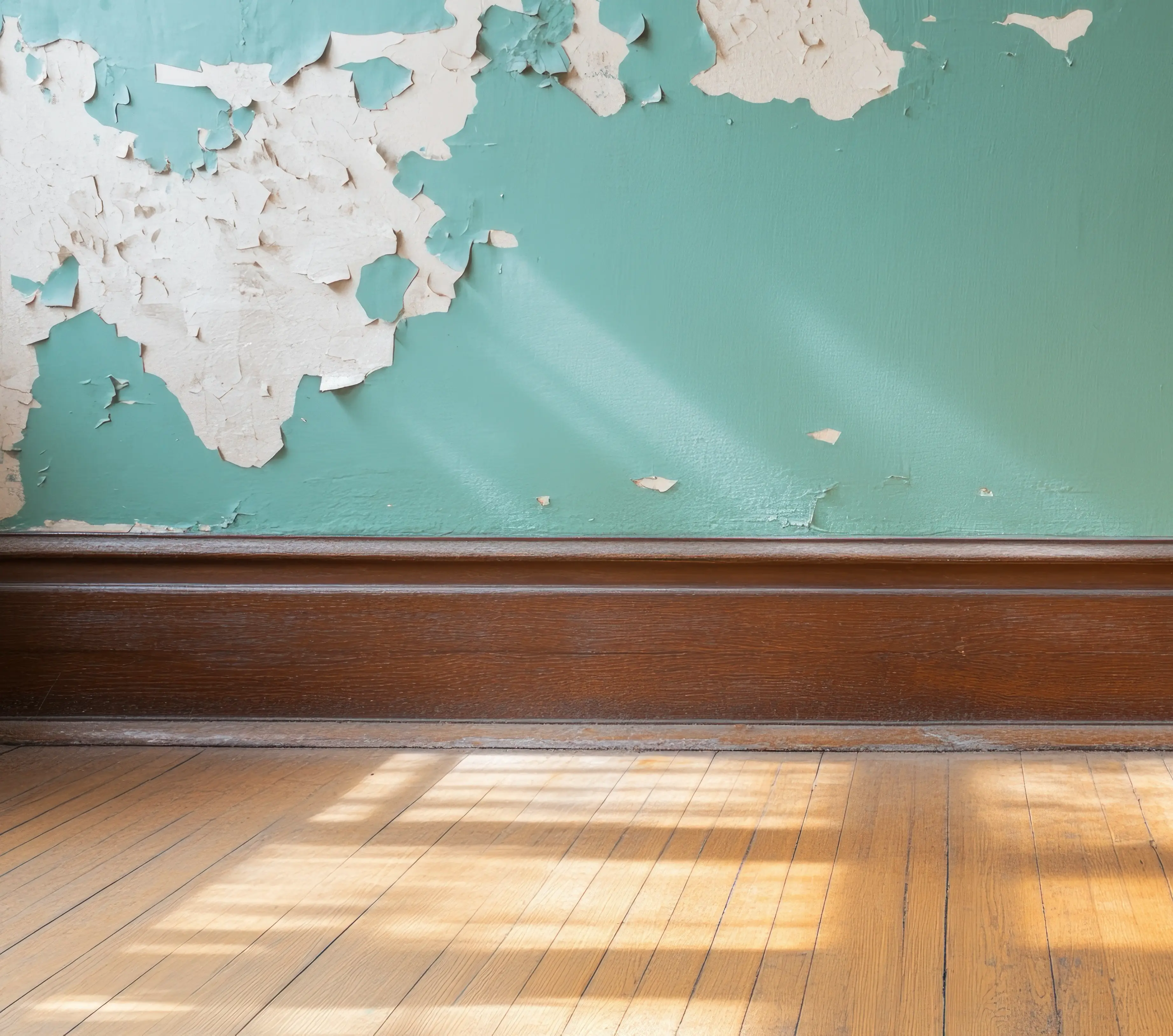
How do you handle homes with peeling or failing exterior paint?
Peeling and failing paint is the most common exterior condition we work with in
Bellingham. We scrape all loose paint to a firm edge, feather and sand transitions
smooth, spot-prime all bare wood with the right exterior primer for that substrate,
and caulk any open joints before topcoats go on. Painting over failing paint without
this prep is the single biggest reason exterior paint jobs fail early — we don't do it.
What kind of exterior paint do you use in the Pacific Northwest?
We use premium exterior coatings — primarily Sherwin-Williams and Benjamin Moore
product lines — selected for the specific substrate and climate exposure. Bellingham's
combination of moisture, UV, and temperature swings demands a coating that flexes
with the wood, resists moisture intrusion, and holds color under years of Northwest
weather. Every bare or repaired surface gets the correct exterior primer before
topcoats are applied.
Do you paint cedar siding and wood shingles?
Yes — cedar siding and wood shingles are common in Bellingham and a surface we
work with regularly. Bare cedar requires an oil-based or shellac-based primer
before topcoats to prevent tannin bleed and ensure proper adhesion. We choose
primers and topcoats specifically for wood movement and moisture resistance in
the Pacific Northwest climate. Skipping this step on cedar is a reliable way to
end up with peeling paint within two years.
Do you offer a warranty on exterior painting?
Yes. Every exterior painting project Ellwanger Painting completes in Bellingham
is backed by a 5-year workmanship warranty on labor and materials.
If the paint fails due to our prep or application, we come back and make it right.
See our full
exterior painting warranty details
.
Do I need to be home during the exterior painting job?summary
You don't need to be home for the work itself, but we ask that someone is
available for the initial and final walkthrough. Day-to-day we just need access to
the exterior of the house.
Can you match my existing exterior color?
Yes. We can use the existing paint can label, a color chip, or take a sample to
a Sherwin-Williams or Benjamin Moore store for a spectrophotometer match. If the
color has faded significantly, a fresh coat of the original color may look slightly
different — we'll flag that before we start.
Do you move patio furniture and plants before painting?
We move and protect anything within the work area — furniture, potted plants,
grills, and any items near the house. We mask off decking, concrete, and
landscaping before any spraying or coating goes on.
What kind of caulk should be used on wet wood siding — for example right after
pressure washing or heavy rain?
For wet or damp wood siding, oil-based or solvent-based caulks are the right
choice. Unlike latex and acrylic caulks, oil-based formulas can penetrate and
adhere to damp wood because the solvent base isn't repelled by surface moisture.
The practical rule: if the wood is surface-damp but not actively shedding water,
an oil-based caulk is workable. If the wood is visibly saturated, wait. We shoot
for below 15% moisture content before caulking or painting. Make sure any
oil-based caulk you choose is paintable — not all are.
How do you identify and prevent moisture rot on older homes?
Moisture rot follows water. The most common culprits on older Bellingham homes:
leaking gutters and fascia boards butted tight against gutter corners; caulking
vertical joints but leaving horizontal joints open (horizontal joints need to
breathe so water drains out); missing or failed flashing at siding butt joints;
siding that rests directly on a roof surface; tight corners without proper corner
trim. Soffit rot on homes with wide 2-foot-plus soffits usually means water is
getting in through the roof overhang assembly above and working its way down into
the interior framing. By the time you see rot in the soffit face there's often more
damage inside — that's a building envelope problem that needs to be addressed
before any coating goes on.
Should I repaint or reside my older Bellingham home if it has lead paint?
It's about encapsulating the lead paint. The advantage of repainting — with
proper scraping and sanding under EPA RRP protocols — is that it stops lead paint
from falling into your yard and keeps it contained. Residing is sometimes the right
call, but contractors who don't follow EPA rules when removing lead-painted siding
create exactly the contamination problem you're trying to avoid. A full exterior
repaint done right runs around $15,000 depending on size and condition. Residing
with Hardie board and re-trimming windows and doors runs $20,000–$30,000. If
$30,000 isn't an option, the realistic path is replacing the worst boards and
repainting. Professional services are expensive — they're worth it, especially if
you have kids. And after you research what's involved in repainting a lead house,
price the tools, and start scraping, you're going to say forget it and hire a pro
anyway.